

 Posts
Posts


My blog is now enabled for mobile viewing.
And, I've got two LadyBug Spinning wheels in stock, brand new and ready to ship. They are priced to sell, so if you've been hankering after a LadyBug, or have questions, send me an e-mail. My phone is very smart - I can get your e-mail no matter where I am...even when I'm fishing.
Saturday, August 6, 2011


NOT Blog AWOL!
Contrary to rumors, I am not Blog AWOL. I have just been very busy! My son got married...that meant I had to weave a bunch of towels as table centerpieces and giveaways at the rehearsal dinner.
 The first set of towels was a red/pink gamp. These towels represented the harmony that can happen in a good marriage.
The second set of towels were made by using all the scraps from all of the cotlin towels I've made, both for the bridal shower and for the rehearsal dinner. I made random stripes in the warp and then wove in a twill using mercerized cotton for the weft.
 These were the "scrap" towels, and they represented the times in life when everything is going wrong and we feel like all we are getting are the scraps of life - the scraps of our spouse's attention, time, love - or when we feel like we have nothing to give but scraps. Scraps are still beautiful and useful. Even the difficult times can be woven together by our Good God.
The rehearsal dinner was a great success and I gave away a dozen towels.
Then I had to make something for my nephew's wedding gift. I made fine linen napkins in a Swedish lace pattern. I made four of them all white, and one of them with natural linen weft, just to see how it looked.
 Whew. No more weddings for a while!
Our spring/early summer was a whirlwind. So in July we did a lot of this.

That is me with a largemouth bass. He was not too happy about the photo and swam away with an angry flip of his fishy tail.
We've got a week at home (weaving, family visits, hot weather) and then a couple more camping trips before school starts, Hubby goes back to the grind, I mean classroom, and the weather is cooler for MORE FIBER ACTIVITIES!
Next weaving project - bamboo towels.
Stay cool!

The second set of towels were made by using all the scraps from all of the cotlin towels I've made, both for the bridal shower and for the rehearsal dinner. I made random stripes in the warp and then wove in a twill using mercerized cotton for the weft.

The rehearsal dinner was a great success and I gave away a dozen towels.
Then I had to make something for my nephew's wedding gift. I made fine linen napkins in a Swedish lace pattern. I made four of them all white, and one of them with natural linen weft, just to see how it looked.

Our spring/early summer was a whirlwind. So in July we did a lot of this.

That is me with a largemouth bass. He was not too happy about the photo and swam away with an angry flip of his fishy tail.
We've got a week at home (weaving, family visits, hot weather) and then a couple more camping trips before school starts, Hubby goes back to the grind, I mean classroom, and the weather is cooler for MORE FIBER ACTIVITIES!
Next weaving project - bamboo towels.
Stay cool!
Tuesday, April 26, 2011
No Sheep Shawl - Camel, Alpaca, Cashmere and Silk
I thought I'd end up knitting with my handspun cashmere laceweight but I was wrong. I had almost 2200 yds of handspun baby camel/alpaca/silk (my own blend) stuffed away in a plastic bag with no purpose in life, and it had high enough twist to use as warp. I found a Huck Lace draft I liked, did my calculations, and measured the warp.
Then I sized the warp with Good Old Rabbit Skin Glue, let it dry overnight, and warped my loom.
Halfway through dressing the loom I just had to take a photo of the sheer orderliness of it all. I had no idea I could get excited about the fiddly, perfectionist activity of dressing a loom. It is nice to discover unknown things about oneself!

The weaving itself was quick. I only had two delays. First, I ran out of weft yarn when I was 14" from the end. Oops. I guess my calculations were off. So much for my newly discovered inner perfectionist. Fortunately I had more of the fiber on hand so I spun another 400 yds of the cashmere and left it to set on the bobbin while I went on a cruise with my daughter. That was the other delay. Here I am, not spinning or weaving. And yes, it is a full-body swim suit. You can buy one here if you hate sunburn and naked legs as much as I do.

When I returned the cashmere was ready to ply. Once the yarn was finished I got back to weaving, and it took only an hour or so to finish. Because of the rabbit skin sizing, the piece of cloth was a little on the stiff side. I reminded myself that sizing rinses out. That kept me from panicking. Who wants a STIFF cashmere shawl?
I tied all the fringe and trimmed it. Then I soaked the shawl in hot water with a little Woolite, spun off the water, rolled it in a towel, and laid it flat to dry.
The sizing washed out. The shawl is To Die For soft. I am please with the results and now I need an entire new outfit to wear with it.


WHAT I LEARNED:
1. I love rabbit skin sizing even more than ever. I broke exactly NO warp ends during weaving.
2. Make enough weft to start with. Plan to use more than calculated.
3. Huck usually has a plain weave selvedge. I did make a plain weave selvedge but I doubled the last four ends and did NOT like the results. I will just use PLAIN plain weave next time.
4. I tend to stretch my left selvedge. Next time I will probably weight the last two selvedges separately.
5. The most painful thing about weaving with handspun is all the loom waste. It was VERY PAINFUL to cut the thrums from the loom at the end.
6. There is a reason cashmere is so expensive. This is THE softest garment I have ever owned.
7. There is a reason most weavers buy commercial yarn. Spinning the fiber adds weeks of time to a project.
8. There is a reason some of us are crazy enough to spin some of our weaving yarn. S-A-T-I-S-F-A-C-T-I-O-N.
Then I sized the warp with Good Old Rabbit Skin Glue, let it dry overnight, and warped my loom.
Halfway through dressing the loom I just had to take a photo of the sheer orderliness of it all. I had no idea I could get excited about the fiddly, perfectionist activity of dressing a loom. It is nice to discover unknown things about oneself!

The weaving itself was quick. I only had two delays. First, I ran out of weft yarn when I was 14" from the end. Oops. I guess my calculations were off. So much for my newly discovered inner perfectionist. Fortunately I had more of the fiber on hand so I spun another 400 yds of the cashmere and left it to set on the bobbin while I went on a cruise with my daughter. That was the other delay. Here I am, not spinning or weaving. And yes, it is a full-body swim suit. You can buy one here if you hate sunburn and naked legs as much as I do.

When I returned the cashmere was ready to ply. Once the yarn was finished I got back to weaving, and it took only an hour or so to finish. Because of the rabbit skin sizing, the piece of cloth was a little on the stiff side. I reminded myself that sizing rinses out. That kept me from panicking. Who wants a STIFF cashmere shawl?
I tied all the fringe and trimmed it. Then I soaked the shawl in hot water with a little Woolite, spun off the water, rolled it in a towel, and laid it flat to dry.
The sizing washed out. The shawl is To Die For soft. I am please with the results and now I need an entire new outfit to wear with it.


WHAT I LEARNED:
1. I love rabbit skin sizing even more than ever. I broke exactly NO warp ends during weaving.
2. Make enough weft to start with. Plan to use more than calculated.
3. Huck usually has a plain weave selvedge. I did make a plain weave selvedge but I doubled the last four ends and did NOT like the results. I will just use PLAIN plain weave next time.
4. I tend to stretch my left selvedge. Next time I will probably weight the last two selvedges separately.
5. The most painful thing about weaving with handspun is all the loom waste. It was VERY PAINFUL to cut the thrums from the loom at the end.
6. There is a reason cashmere is so expensive. This is THE softest garment I have ever owned.
7. There is a reason most weavers buy commercial yarn. Spinning the fiber adds weeks of time to a project.
8. There is a reason some of us are crazy enough to spin some of our weaving yarn. S-A-T-I-S-F-A-C-T-I-O-N.
Friday, March 11, 2011
Twill Towels - Cotton/Linen Adventure

I got a very good deal on some WEBS 8/2 Cotlin (50% cotton, 50% linen) so I bought about a dozen cones in various colors. I also had some cones of BORGS "Bomullin" which is the same fiber content but made in Sweden. I thought I'd make towels from both and compare.
I used 8/2 mercerized cotton for the warp and sett it at 24 ends per inch, as for twill. I had a cone each of white and natural so I wound them together and figured no one would be able to tell. I was right about that!
I planned for six towels, 22 x 38 on the loom with a 1 inch hem of 10/2 white cotton at each end. I also left myself some room to goof off at the end and I'm glad I did because I made a nice discovery. More about that later.
First I wove the brick red towels. This was the Swedish cotlin. Here are the close ups.


Next I wove two green towels using a second treadling and making them different by adding a horizontal stripe to one.


What I learned:
The Swedish cotton/linen was far superior to the WEBS. It also costs twice as much, so if I were making a VERY VERY special project I'd be tempted to use only the Swedish. The hand of the final cloth was crisper (like linen) and it didn't make any fuzz while I wove. It also didn't need any ironing right out of the dryer. The WEBS cotton/linen is softer and fuzzier. I imagine it will not wear as well over time but the price could not be beat so I'm not unhappy with the purchase and have a lot more of it for other projects.
I learned that I have a hard time keeping track of even the simplest treadling sequences. If my mind wanders, I mess up. So, I assign a note of the scale to each treadle and sing a little song while I weave. It's boring, and the words are the numbers of the treadles, but it WORKED FOR ME.
I also learned not to freak out if the weaving doesn't look like the picture in the book. I sleyed the reed 3 threads to a dent. This created little tracks in the cloth and at first I thought I'd threaded the whole thing wrong. Nope. After I washed the towels they were perfect.
Finally, I learned that I REALLY like the cotton flake towel! The dense sett of the warp made for a nice, firm fabric. It's heavy but not at all stiff. It would make a wonderful bath towel! If I hadn't left myself room to experiment I probably would not have discovered this - usually cotton flake is woven at 10-12 epi.
The hemmed and finished towels are 19 x 34.5. I am beginning to understand why towel weaving is so addicting.

Friday, February 11, 2011
Spinning Dog Fur: A Poodle Adventure
Meet Carl, the 80-pound standard poodle. Before I learned to spin he was just a great, big, furry, lovable, happy pal. Once I started spinning I began to eye him in a new way.

All those lovely black curls...
Tightwad that I am, I decided not to let Carl's coat end up in the groomer's wastebasket.
My first attempt at harvesting his coat was disaster, but I learned something important. Wash dog first. THEN clip. I assumed I could treat a poodle coat like a fleece. I clipped the dog and washed the fur very, very gently in shampoo. It turned into a mass of black felt. I salvaged less than half an ounce, spun a tiny ball of 2-ply, sent it to Spin-Off and got it pictured in the fall 2009 issue, but that was it.
Last spring I was ready. I washed the dog FIRST. Let him dry. Combed out the tangles. Then I clipped off the best parts of his coat - like a sheep's fleece, that was the neck, back, sides, and rump. I didn't bother with the rest. I took him to the groomer looking like an advertisement for mange and carried on with my fiber fun.
Despite how soft my dog feels when I pet him, his fur was somewhat wiry. The crimp is open. Because he is middle-aged there are now a lot of white hairs mixed in. So I decided to blend the dog fur with natural black merino. I carded up four big batts.
I don't remember why, but for some reason I had to set aside the project at this stage. I laid the batts carefully over the back of an old sofa in the basement and decided to get back to it when I had time. Fast forward to this fall. When I went to finish the carding, half the fiber had felted, JUST from the summer heat and humidity of my basement. I have never had t his happen, not even to rabbit angora. I threw the matted junk away and re-carded what was left. I carded it three times.
Here is what I ended up with - poodle/merino roving.

It was NOT easy to spin! I swear the fiber WANTS to felt. It felted when I looked at it. It felted as I spun. It was hard drafting but finally I finished the yarn - 400 yds of two-ply, just in time for our Fiber Guild meeting. I skeined it and made it into a yarn twist. That was less than two weeks ago.

Today I took the UNTOUCHED skein out of the closet. The strands are felting together. Can't blame humidity this time of year - it is dry, dry dry.

What I learned:
1. My dog's fur is great for felting.
2. I don't love spinning dog fur.
3. There is a reason sheep are the primary fleece animal in the world
I probably will not be spinning any more of Carl's fur. But someone is going to get a dandy pair of felted slippers or mittens, courtesy of the family canine.

All those lovely black curls...
Tightwad that I am, I decided not to let Carl's coat end up in the groomer's wastebasket.
My first attempt at harvesting his coat was disaster, but I learned something important. Wash dog first. THEN clip. I assumed I could treat a poodle coat like a fleece. I clipped the dog and washed the fur very, very gently in shampoo. It turned into a mass of black felt. I salvaged less than half an ounce, spun a tiny ball of 2-ply, sent it to Spin-Off and got it pictured in the fall 2009 issue, but that was it.
Last spring I was ready. I washed the dog FIRST. Let him dry. Combed out the tangles. Then I clipped off the best parts of his coat - like a sheep's fleece, that was the neck, back, sides, and rump. I didn't bother with the rest. I took him to the groomer looking like an advertisement for mange and carried on with my fiber fun.
Despite how soft my dog feels when I pet him, his fur was somewhat wiry. The crimp is open. Because he is middle-aged there are now a lot of white hairs mixed in. So I decided to blend the dog fur with natural black merino. I carded up four big batts.
I don't remember why, but for some reason I had to set aside the project at this stage. I laid the batts carefully over the back of an old sofa in the basement and decided to get back to it when I had time. Fast forward to this fall. When I went to finish the carding, half the fiber had felted, JUST from the summer heat and humidity of my basement. I have never had t his happen, not even to rabbit angora. I threw the matted junk away and re-carded what was left. I carded it three times.
Here is what I ended up with - poodle/merino roving.

It was NOT easy to spin! I swear the fiber WANTS to felt. It felted when I looked at it. It felted as I spun. It was hard drafting but finally I finished the yarn - 400 yds of two-ply, just in time for our Fiber Guild meeting. I skeined it and made it into a yarn twist. That was less than two weeks ago.

Today I took the UNTOUCHED skein out of the closet. The strands are felting together. Can't blame humidity this time of year - it is dry, dry dry.

What I learned:
1. My dog's fur is great for felting.
2. I don't love spinning dog fur.
3. There is a reason sheep are the primary fleece animal in the world
I probably will not be spinning any more of Carl's fur. But someone is going to get a dandy pair of felted slippers or mittens, courtesy of the family canine.
Wednesday, February 9, 2011
It's Official! Side-Kick Prices
I just got the news from Schacht - here are the prices on their new travel wheel, the Side Kick.
The Sidekick package (full wheel, bobbins, etc) is $785.
And here is some GREAT news for those who already own a Lady Bug or Matchless - The Side Kick is available without whorls, bobbins or a flyer for $665. If you are happy to share parts between your wheels, you can get this fantastic travel wheel for a considerable savings!
The Bulky Flyer kit is an additional $260.
I am taking pre-orders. $200 down will reserve your place in line. Don't wait!

The Sidekick package (full wheel, bobbins, etc) is $785.
And here is some GREAT news for those who already own a Lady Bug or Matchless - The Side Kick is available without whorls, bobbins or a flyer for $665. If you are happy to share parts between your wheels, you can get this fantastic travel wheel for a considerable savings!
The Bulky Flyer kit is an additional $260.
I am taking pre-orders. $200 down will reserve your place in line. Don't wait!

Monday, January 31, 2011
Spinning With Cashmere
In 2008 I traveled to China with my daughter's college choir. While we were touring a cashmere factory I got our translator to ask the manager of the factory if I could buy just a little unspun fiber. I (and the translator) had to ask three times. "No," said the manager when he finally understood. We don't sell such a thing." He pointed to the showroom where they sold everything from rugs to sweaters to little stuffed kittens. He couldn't understand why any sane person would want the fluff. I think he felt a little insulted, too. He was real frowny.
SO since I couldn't get even a pinch of cashmere in China, I bought some here. And guess where it came from? Yep. China. Mongolia, to be exact. The following is an account of this spinning adventure.
I bought 8 ounces of cream colored cashmere top and when it arrived I just stuck my hand in the bag and touched it. It almost felt like touching NOTHING at all. I fluffed the top a bit and started to spin - using the fastest ratio on my Souped up Suzie. I wanted as many yards as possible - spinning pure gold. To make it go even farther, I planned to ply with a fine silk thread.

I found it was difficult to keep a very even draft - lots of little slubs. The fiber was fine but not slippery, and the top was fairly compacted. Had I been spinning on a drop spindle I would have had more consistency, but I was in a hurry this time.
I finally settled on a long draw spinning from a hunk of the top torn off and folded in half. I didn't fold it OVER my finger, I just folded and spun from the point of the fold. I was able to spin fast and fairly evenly.

By the time I had two full Majacraft lace bobbins I was sick of looking at cashmere. I still had to ply. I figured I'd had enough. I let it sit for a week to set the twist then plied it with silk thread.


Final counts: 4.6 ounces of silk-plied cashmere is 1693 yds. In other words, 368 yds/oz. You can see in the close up that the strands are not perfect - some are fluffier than others! The overall feel of the yarn is soft, soft, soft and very cushy.

Knitted into lace it will have a lustrous drape and will weigh next to nothing. I haven't decided if I will knit or weave it.
SO since I couldn't get even a pinch of cashmere in China, I bought some here. And guess where it came from? Yep. China. Mongolia, to be exact. The following is an account of this spinning adventure.
I bought 8 ounces of cream colored cashmere top and when it arrived I just stuck my hand in the bag and touched it. It almost felt like touching NOTHING at all. I fluffed the top a bit and started to spin - using the fastest ratio on my Souped up Suzie. I wanted as many yards as possible - spinning pure gold. To make it go even farther, I planned to ply with a fine silk thread.

I found it was difficult to keep a very even draft - lots of little slubs. The fiber was fine but not slippery, and the top was fairly compacted. Had I been spinning on a drop spindle I would have had more consistency, but I was in a hurry this time.
I finally settled on a long draw spinning from a hunk of the top torn off and folded in half. I didn't fold it OVER my finger, I just folded and spun from the point of the fold. I was able to spin fast and fairly evenly.

By the time I had two full Majacraft lace bobbins I was sick of looking at cashmere. I still had to ply. I figured I'd had enough. I let it sit for a week to set the twist then plied it with silk thread.


Final counts: 4.6 ounces of silk-plied cashmere is 1693 yds. In other words, 368 yds/oz. You can see in the close up that the strands are not perfect - some are fluffier than others! The overall feel of the yarn is soft, soft, soft and very cushy.

Knitted into lace it will have a lustrous drape and will weigh next to nothing. I haven't decided if I will knit or weave it.
Friday, January 28, 2011
Side Kick - Price and Pre-Ordering
Schacht has not finalized the price on the Side Kick travel wheel yet, but rumor has it that it will retail for around $800. The wheels will start shipping in May, but NOW is the time to get on the list if you want to be first in line. They already have a growing number of pre-paid customers.
For $200 down I will pre-order your wheel. Pre-orders need to be placed by the end of Feb but a queue is already forming so the sooner we get your wheel ordered, the sooner you will get it after the wheels start shipping.


For $200 down I will pre-order your wheel. Pre-orders need to be placed by the end of Feb but a queue is already forming so the sooner we get your wheel ordered, the sooner you will get it after the wheels start shipping.


Monday, January 17, 2011
Woollen Longdraw - for handspinning
Here is a nice video on how to do a woollen long-draw. If you find the music distracting go ahead and mute the sound - the entire lesson is visual.
Happy Spinning!
Thursday, January 13, 2011
Schacht SideKick! A Sneak Peek
IS THIS CUTE OR WHAT???
The rumors are true! Schacht has been working on a folding wheel for over a year. Finally we got the announcement - the SideKick is due to start shipping in May!
As soon as I have prices I will offer the wheel for pre-sale orders.
Here are some of the Sidekick’s features:
Folds to 21 1/2" x 15" x 8 1/4".
Integrated storage of bobbins, flyer, and whorls for transport.
Lightweight at 13 pounds.
13 3/4" drive wheel allows for ratios from 4.25 to 15.25.
Long, comfortable treadles.
Uses the same bobbins, whorls, and flyer as the Schacht Matchless and Ladybug wheels.
The Sidekick can be purchased without the bobbin-flyer assembly.
25" orifice height for comfortable spinning.
Employs Scotch tension with precise control knob.
The drive wheel spins on ball bearings. The flyer turns on self-aligning bearings.
Drive band tension adjuster allows for all whorls to be used with one drive band.
The Sidekick comes with 3 bobbins, 2 whorls, threading hook, and adjustable carrying strap.
Also available: The Sidekick Bulky Plyer Flyer Package can be added at any time.
This wheel will have all the Schacht features that discriminating spinners have come to expect - solid construction, precision engineering, and good looks to boot!
For comparison, the LadyBug weighs 13.5 pounds too, so this wheel isn't lighter. Its advantage is that it can be packed up into a smaller package. And, unlike the LadyBug, it does not have the option of double drive.
Tuesday, January 4, 2011
Weaving a Handspun (mostly) Blanket
This adventure started with a couple thousand yards of gray Romney-Mohair 2-ply, dyed blue. Read here about the dyeing adventure. I could have made a sweater but couldn't summon the Knitting Muse. I decided to weave a blanket instead, and give it to my son for Christmas. He's a doctoral student at the U of Iowa and is grateful for any and all free stuff. I knew that no matter how it turned out he'd like it.
My big loom is only 35" wide so I calculated for twice the finished length at a fairly loose sett of 8 ends per inch. I figured on a lot of shrinkage during finishing and wanted the blanket to retain a drapey, soft feel. I dyed white sport weight Bartlettyarn in three warp groups using the kettle method and two colors - scarlet red and royal blue.


After the loom was dressed it only took a few sessions to do the actual weaving. When I cut the piece from the loom it was 15 feet long and 34" wide. I zig-zagged the raw ends (which had a wool header) and washed the whole thing in the washing machine, delicate cycle, with Woolite. Then I dried it on the FLUFF cycle in the dryer. It was nicely fulled when I took it out.
I cut the blanket in two and once again zigzagged the edges with black silk thread, and then seamed the two pieces side-by-side by hand with weft yarn in an overcast stitch. The last thing I had to decide was how to finish the ends.
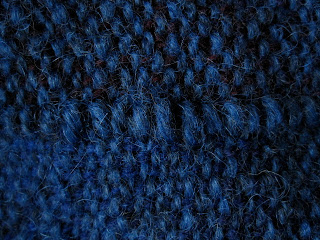
I thought about making a binding of some kind but the blanket fabric is quite thick and I didn't want a "hard" edge. After a couple of trial runs I decided on a blanket stitch hem along the turned-over edge.

Here is the finished blanket on my studio floor.


And here it is, on my son. (I sewed the gnome hat by special request. He's an English Lit scholar and said that if Scrooge has a nightcap, he wanted one too.)

I'm glad I took the risk on a BIG PROJECT! The finished size of the blanket is 62" wide and 74" long. It is fuzzy and has a nice drape, and is WARM! Best of all, it was Made By Hand, With Love.
My big loom is only 35" wide so I calculated for twice the finished length at a fairly loose sett of 8 ends per inch. I figured on a lot of shrinkage during finishing and wanted the blanket to retain a drapey, soft feel. I dyed white sport weight Bartlettyarn in three warp groups using the kettle method and two colors - scarlet red and royal blue.


After the loom was dressed it only took a few sessions to do the actual weaving. When I cut the piece from the loom it was 15 feet long and 34" wide. I zig-zagged the raw ends (which had a wool header) and washed the whole thing in the washing machine, delicate cycle, with Woolite. Then I dried it on the FLUFF cycle in the dryer. It was nicely fulled when I took it out.
I cut the blanket in two and once again zigzagged the edges with black silk thread, and then seamed the two pieces side-by-side by hand with weft yarn in an overcast stitch. The last thing I had to decide was how to finish the ends.

I thought about making a binding of some kind but the blanket fabric is quite thick and I didn't want a "hard" edge. After a couple of trial runs I decided on a blanket stitch hem along the turned-over edge.

Here is the finished blanket on my studio floor.


And here it is, on my son. (I sewed the gnome hat by special request. He's an English Lit scholar and said that if Scrooge has a nightcap, he wanted one too.)

I'm glad I took the risk on a BIG PROJECT! The finished size of the blanket is 62" wide and 74" long. It is fuzzy and has a nice drape, and is WARM! Best of all, it was Made By Hand, With Love.
Wednesday, December 15, 2010
Cotton Towels. Can't You Get Those at Wal-Mart?
For as long as I can remember I have knitted Christmas gifts for everyone in the family. This year, I'm weaving. Here are some of my projects and what I've learned from them.
Cotton Dish Towels. When I first joined our local Fiber Arts Guild, before I learned to weave, I was struck by how many weavers made towels. Towels? I had that "can't you buy those at Wal-Mart?" moment, but once I started weaving I was intrigued. For one thing, though I knit a lot, I rarely use cotton. Using a new fiber sounded like an interesting adventure. Second, I got a really good deal on some monster cones of cotton.

The towel on the far left was made with leftovers from a color gamp kit. I had rainbow cones with a lot of thread left, and nothing to do with them! I designed this simple twill towel. It is 10/2 perle cotton set at 30 e.p.i. When I took it off the loom I was in love. After I washed and dried it, it became my new favorite. Here's a close up of the twill.

The next three towels are in a pattern draft called M's and O's from The Handweaver's Pattern Dictionary, p. 129. I used one threading for all three towels and had planned to use three different treadling sequences, but I liked #2 so well that I never got to #3. The warp is 8/2 cotton set at 20 epi. The weft is cotton flake.
What I learned.
1. I had to use a stretcher/temple for these projects in order to keep my fell line straight. Unlike wool, cotton has very little give.
2. Cotton shrinks. A lot. Really a lot. Each towel shrunk at least 4 inches in length and 3+ inches in width. Shrinking is a bonus too - any loose weave places close up. What looks like funky bad weaving disappears.
3. All Flake Cotton Is Not Equal. I got the cones of flake cotton as a bargain basement item from a weaving store. After washing it was obvious that at least one of the colors was not going to stand up to years and years of washing and drying.
4. Weaving cotton is noisier. My big loom is upstairs and the noise I made beating the cotton weft into place (two beats, one on the closed shed, one on the next open shed) drove my poor husband nuts. I had to weave cotton when he was at work. Another reason to have two looms - one with a quiet project, the other with cotton.
5. Finally, I LOVED MAKING TOWELS. While I was doing this project I "won" an Ebay sale - 20 new cones of linen weaving thread for next to nothing.
I hope my relatives and friends like handwoven towels. I can see a future in this.
Cotton Dish Towels. When I first joined our local Fiber Arts Guild, before I learned to weave, I was struck by how many weavers made towels. Towels? I had that "can't you buy those at Wal-Mart?" moment, but once I started weaving I was intrigued. For one thing, though I knit a lot, I rarely use cotton. Using a new fiber sounded like an interesting adventure. Second, I got a really good deal on some monster cones of cotton.

The towel on the far left was made with leftovers from a color gamp kit. I had rainbow cones with a lot of thread left, and nothing to do with them! I designed this simple twill towel. It is 10/2 perle cotton set at 30 e.p.i. When I took it off the loom I was in love. After I washed and dried it, it became my new favorite. Here's a close up of the twill.

The next three towels are in a pattern draft called M's and O's from The Handweaver's Pattern Dictionary, p. 129. I used one threading for all three towels and had planned to use three different treadling sequences, but I liked #2 so well that I never got to #3. The warp is 8/2 cotton set at 20 epi. The weft is cotton flake.
What I learned.
1. I had to use a stretcher/temple for these projects in order to keep my fell line straight. Unlike wool, cotton has very little give.
2. Cotton shrinks. A lot. Really a lot. Each towel shrunk at least 4 inches in length and 3+ inches in width. Shrinking is a bonus too - any loose weave places close up. What looks like funky bad weaving disappears.
3. All Flake Cotton Is Not Equal. I got the cones of flake cotton as a bargain basement item from a weaving store. After washing it was obvious that at least one of the colors was not going to stand up to years and years of washing and drying.
4. Weaving cotton is noisier. My big loom is upstairs and the noise I made beating the cotton weft into place (two beats, one on the closed shed, one on the next open shed) drove my poor husband nuts. I had to weave cotton when he was at work. Another reason to have two looms - one with a quiet project, the other with cotton.
5. Finally, I LOVED MAKING TOWELS. While I was doing this project I "won" an Ebay sale - 20 new cones of linen weaving thread for next to nothing.
I hope my relatives and friends like handwoven towels. I can see a future in this.
Subscribe to:
Posts (Atom)
