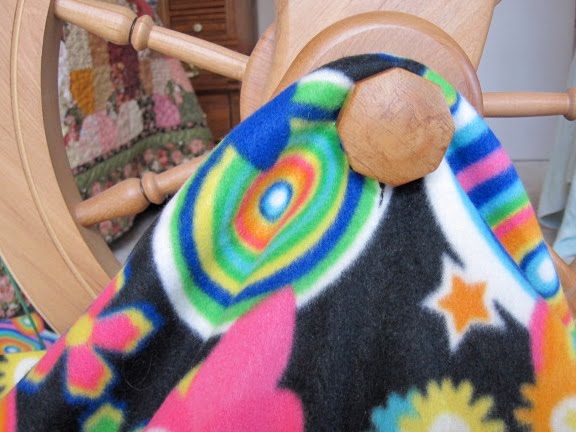
Here is a quick, inexpensive way to wrap your Suzie or Rose for transport.
You will need 2 yds of polar fleece fabric, medium to heavy weight and a pair of sharp scissors. You will also need a Rose or Suzie spinning wheel. If you don't have one yet, call or e-mail and I will be happy to help you remedy the situation.
Lay the fabric out on the floor and set your spinning wheel toward the end that is nearest to you, as you would face it to spin. Loosen the wheel knob and fold the wheel down so the handle is sticking up, then re-tighten the knob to secure it. If you have a Suzie, bring the close end of the fabric up and poke two holes where the bobbin holders are, and slip the fabric down over the spindles. If you have a Rose, snip a hole big enough to accommodate the wooden knob on wheel assembly.
Next, take the corners of the fabric closest to you, and tie them in a big square knot at the back of the wheel, covering the conrods.
Now take the rest of the fabric from behind, and drape it over the front of the wheel. Pull the fabric slightly so that all is taut on the back side. Poke another hole and fit it over the front knob. It should be a snug fit. Once the fabric is secured to the knob, find the handle and cut a hole slightly smaller than the handle but big enough for the handle to poke through. Be careful not to scratch the handle.
Last, gather up the remaining two corners of the fabric, bring them around to the front of the wheel and tie another square knot. Your wheel is snug in its cozy and you're ready to go!
Monday, April 19, 2010
Friday, April 16, 2010
Fiber Orphans, Part One
Our church crafter's group made Prayer Shawls during Lent. Our goal was 40 shawls during the 40 days of Lent, and we made 47! They will go to the local nursing home. It was a great project and a lot of people contributed, both money for yarn and time spent knitting, crocheting and praying!
I made four adult-sized prayer shawls and while I was knitting and thinking about the dear old folks who would receive them, I thought I'd like to make a little prayer shawl for a four-year-old little friend of mine. She is very girly and loves pink, loves to cuddle and still sucks her thumb. I had a 4 ounce washable merino roving that was part of my orphaned fiber stash (dyed, but no plan) and so I set myself a goal of seeing how fast I could do the project.
I divided the wool in half and spun it with a long draw, paying little attention to grist. I spun what I spun. After one night on the bobbins, I plied the two together. Time spend spinning - 3 hours. I finished the yarn and once it was dry, I started to knit. I had just under 300 yards of thick 'n thin.
We were using a triangular shawl pattern that called for heavy yarn and size 13 needles. I figured I could make a mini version using size 7 needles. I cast on, knitted the shawl, and cast off. I had ONE YARD of yarn left! Whew! Time spent knitting - 3 hours. It was exactly the right size for a little girl and I have been informed that it lives in the pile of snuggle blankies on my little friend's bed.
I am working at using my orphan fiber. I've got rovings, carded batts, and a lot of yarn that never made it to a project. Please tell us about any orphan projects you've recently completed, or you plan/strategy for using up stash!
More about Fiber Orphans in upcoming posts.
I made four adult-sized prayer shawls and while I was knitting and thinking about the dear old folks who would receive them, I thought I'd like to make a little prayer shawl for a four-year-old little friend of mine. She is very girly and loves pink, loves to cuddle and still sucks her thumb. I had a 4 ounce washable merino roving that was part of my orphaned fiber stash (dyed, but no plan) and so I set myself a goal of seeing how fast I could do the project.
I divided the wool in half and spun it with a long draw, paying little attention to grist. I spun what I spun. After one night on the bobbins, I plied the two together. Time spend spinning - 3 hours. I finished the yarn and once it was dry, I started to knit. I had just under 300 yards of thick 'n thin.
We were using a triangular shawl pattern that called for heavy yarn and size 13 needles. I figured I could make a mini version using size 7 needles. I cast on, knitted the shawl, and cast off. I had ONE YARD of yarn left! Whew! Time spent knitting - 3 hours. It was exactly the right size for a little girl and I have been informed that it lives in the pile of snuggle blankies on my little friend's bed.
I am working at using my orphan fiber. I've got rovings, carded batts, and a lot of yarn that never made it to a project. Please tell us about any orphan projects you've recently completed, or you plan/strategy for using up stash!
More about Fiber Orphans in upcoming posts.
Monday, April 12, 2010
MAJACRAFT ROSE: A Thorough Review
My friend Kerry sent me this link. It's a very nice review of the Majacraft Rose. Keep in mind that the review was made in 2007 - several improvements have been made since then, for instance, the flyer bars have been made more aerodynamically efficient. The standard orifice is now made of stainless steel, and the bearings (which were always great) have been improved. Hinges have been upgraded...AND the price has definitely gone up :-)
It is still one of the nicest "everything" wheels available. Dollar for dollar, I believe it is the best spinning wheel in its class.
This month every Rose wheel comes with ALL the Majacraft whorls. Spin thread, spin rope. You choose!
It is still one of the nicest "everything" wheels available. Dollar for dollar, I believe it is the best spinning wheel in its class.
This month every Rose wheel comes with ALL the Majacraft whorls. Spin thread, spin rope. You choose!
Friday, April 9, 2010
Weave It Away - Super Stash Reduction!
If you are like me you have many, MANY skeins, balls, yarn-cakes, cops and other blobs of yarn. You spun it, you bought it, you stored it...sometimes for a long time.
I am finding that learning to weave is a very quick and easy way to use up odds and ends.
A while back I did an experiment with core spinning. I dyed a pot of alpaca - just squirted in three colors of dye and let it sit. When I was finished I had a bag of multicolored alpaca locks. I also had a cone of very fine silk 2-ply. I decided to grab bits of alpaca on the fly and spin it around the silk.
The results: 1200 yds of somewhat oddball, thick and thin, fuzzy and smooth alpaca multi. I knitted a swatch. I felt it was somewhat blah, so it sat in my bin. Until yesterday.
I warped my Cricket Loom with a store-bought bamboo-silk yarn and wove the alpaca right as it came off the ball. It took half an hour to warp the loom and about an hour to weave a 6 foot scarf. The MINUTE it was off the loom my husband claimed it. It is heavy, soft, drapey, and the bamboo/silk warp shows through enough to give the whole piece a nice sheen.
A yarn that was ugly when knitted is beautiful when woven. Weaving was fast. I didn't have to buy yarn. And best of all, I have at least half of the alpaca yarn left and will try it with another, finer warp.
Tuesday, April 6, 2010
Learning to Spin, Learning to Weave
I never cease to marvel at the difference between how children react when they see me spinning and how adults react. Here are some typical responses.Kid Questions: Is it fun? Can kids do that? Was the sheep purple? Why did you take off your shoes? Can I try it?
Adult Questions: Is it hard? How long does it take to make yarn? Why would you spin when you could just buy the yarn? Did it take a long time to get good? Oh, I could never do that...
Guess which group of people is harder to teach?
Is it worth pondering. Why do so many adults approach new tasks with the certainty of failure? Why are they so discouraged by the fact that it takes TIME and PRACTICE to master a new skill? Our brains are marvelous! There is no real barrier to learning a new skill - except attitude.
I am living proof that 1. adults can learn new skills, and 2. adults can MASTER a craft if they will put their minds to it. In under three years I have gone from never having touched a spinning wheel to being able to spin anything I want, spin on any wheel, take a wheel apart and put it together again, and teach others the skill. I am not some kind of craft genius. I am an ordinary middle-aged woman, but when I decide to learn something, I throw myself into it like a child. That's the key. Be a kid.
I CAN learn. I WILL improve. NO TOOL is smarter than I am. I call this the Crrafter's Mantra!
I am learning to weave. (Why not? I have a LOT Of yarn around!) In fact, I have added a Schacht Loom dealership to my business. So far I have made three scarves and nine coasters. I have also spun up 4 ounces of merino with the intention of using it for weaving. Right now I am a Child Weaver, with less skill than the tiny girl in the photo, but that is going to change. I am going to become a GOOD WEAVER. Not overnight, not in a week or a month. It will take AS LONG AS IT TAKES!!
More about Schacht Weaving products later! Contact me if you want a loom and I'll make you a deal you can't resist :-) In the meantime, whatever your craft, say the Crafter's Mantra a few times each day.
Friday, April 2, 2010
MAJACRAFT - The New Wheel is Coming!

Here is all I know. It makes yarn. Seriously. The only info I could get out of Glynis was that I would not need the high speed accelerator any more. "The ratios will be adequate for your spinning," she said.
Will it be purple? Will it have spokes like the Rose? Will all my other Majacraft goodies work with it? For now we must remain in the dark.
Mum. They are SO mum.
I will have my new wheel the first of May. Once it has been unveiled at the Maryland Sheep and Wool Festival (Glynis will be there in person!) I can post photos and tell you about it.
Glynis assures me that I will have it in time for the Minnesota Shepherd's Harvest Festival on May 8 and 9. I'll have a booth there, all my Majacraft wheels, lots of wool, and some Schacht looms. Come and see me (and the new wheel) if you are in the neighborhood!
Tuesday, March 23, 2010
MAJACRAFT PIONEER: UPDATED!
Here is the breaking news - just came in tonight! The Pioneer has a new look. I've got one on the way and can't wait to put it together.
From Majacraft:
Majacraft as always, are trying to make craft tools that work great and look fantastic too. So based on this philosophy, we have set about changing and improving the aesthetics of the Pioneer.
The base and pedals of the Pioneer are now in solid pine (pinus radiata), similar to the stem. It is a heavier wood than the original plywood so the overall look of the wheel is much more solid. We have changed the finish from a cream wash to a warm honey coloured oil which accents the natural lustre and grain of the timber.
It also comes standard with our new aerodynamic flyer and 5-ratio whorl. And as with all Majacraft wheels it has the ability to fit all of our accessories.
All of our pine timber is sourced directly from our NZ supplier, which is all grown sustainably here in New Zealand.
Monday, March 1, 2010
Lace Knitting: A Form of Insanity
Handspun, home-dyed, hand-knitted. Why do I do this? My friends can't understand it. I could be knitting warm hats or useful socks but no, I spend weeks making things like this.
Here are some of the reasons knitting lace is fun.
1. It is a huge challenge. Call it the Olympic Knitter in my heart.
2. It requires incredible concentration. This is good for my brain. Alzheimer's Prevention.
3. I get to make something big with a small amount of luxury fiber. This appeals to the tightwad in me.
4. Makes good gifts. Yeah, yeah, it might end up on the back of someone's sofa. Who actually WEARS these things? But it is a gift guaranteed to be appreciated. It is unique and beautiful.
5. Forces me to do math in my head. CONSTANT math in my head. See #2 above.
For this shawl I spun very fine singles of Cormo, alpaca and bunny angora. The alpaca was dyed pink and blue but the Cormo and bunny were white. I got a somewhat mottled, light pink yarn. I plied the singles with fine silk thread.
After knitting this gigantic thing (6 feet across) I realized I didn't like the color. So before blocking I put the whole thing into the dyepot with one tablespoon of burgundy dye. The color is EXACTLY what I wanted and the white blotches were fixed.
I plan to wear this shawl to my daughter's senior recital. Now I need a new dress.
That is the other reason to make a shawl.
Tuesday, February 23, 2010
Souped-Up Suzie for Speed Demons
The other day I had a very pleasant Skype chat with fellow spinner James Perry. He showed me his version of the Souped Up Suzie - he'd replaced the large whorl on his high-speed head with the regular Suzie whorl and upped his ratios significantly.
I thought I could do one better, and so this morning I replaced the large whorl on my high speed head with...the SLOW WHORL. Putting it to its opposite use seemed ironically funny to me, as well as sensible.
The small secondary drive belt that comes with the high speed head was not big enough to fit my new setup, so I made a new small belt, 45.5 cms long. It fitted perfectly. In the photo you can see the difference between the regular high speed whorl and the slow whorl.
Next I figured the ratios. I put a small piece of tape at the top of the drive wheel, and, turning the drive wheel slowly with my right hand, I counted how many times the shaft rotated by counting how many times the grub screw on the brass sleeve came around. One rotation of the drive wheel gave me (are you ready?) 39:1 with the secondary drive band on the larger of the two small shaft whorls, and (drum roll) 47:1 with the secondary drive band on the smaller of the shaft whorls. (The drive band was in the largest groove on the main drive wheel.)
Now the REAL test. Could I spin at those rates?
I put on the lace flyer and an empty lace bobbin and threaded it up, adjusted the tension, and grabbed a bit of Dorset roving.
YESSSSSSS! Spinning was WONDERFUL, treadling at about half my regular frenetic pace using a fast long draw. It spun into a very fine, even strand. Since I am lately obsessed with lace, I couldn't be happier.
So, here is what you need, fellow tinkerers. The high speed head. A slow whorl. A homemade secondary drive band that is 45.5 cms in circumference. I think the lace kit would be best - it is much easier treadling with a smaller flyer - but might not be absolutely necessary.
I have renamed my slow whorl. It is now the Speed Demon Whorl.
Labels:
accessories,
education,
learning to spin,
Majacraft,
Rose,
spinning terms,
Suzie,
Suzie Pro Alpaca,
technique
Monday, February 22, 2010
Tender Fleece - What Are My Options?
I recently purchased several raw fleeces at top dollar from a reliable wool grower I know. Before purchasing I tested each fleece for soundness - I took small staple samples from at least three places on the fleece and snapped them hard. All seemed strong and sound.
After washing one of the gray fleeces I was surprised to find pale creamy-colored neps (wool balls) throughout the fleece. I tested several more locks and discovered that the fleece was tender. Those neps were the tips of the wool, broken off during a very gentle washing. BAD NEWS!
The photos above are the Before and After shots of a staple of wool with tips, and with tips pulled off.
I called the farmer and she instantly refunded the cost of the fleece.
First of all, how did I miss it when I first tested the wool? Here are a few possibilities. The wool was very greasy. That high amount of lanolin could have given a bit of strength to the staples. I may have tested too large a hunk of fiber at a time. And finally, I REALLY wanted that fleece. So, I probably didn't snap as hard as I should have.
Second, what makes a fleece tender? My farmer friend said MANY things! That particular fleece came from a sheep that had had an infection in her udder while she was trying to nurse twin lambs. Then there was a weird April blizzard - sheep were eating snow while nursing lambs, yet another stress to the system.
Anything that stresses a sheep can cause a weak spot in her fleece during the time of trouble. A sheep can get a tender spot in her fleece if she gets sick, nurses triplets or quads, has a very difficult birth, etc. For a few days, the fleece doesn't grow well and it consequently weak at that place in the staple. This is a good reason NOT to reserve fleeces from farmers ahead of time - a fleece that was perfect one year may have faults the next, even with the very best care and feed available. It is also a very good reason to buy ONLY from a farmer who will give you a money-back guarantee of quality.
So, what are the options? If this fleece is carded as-is, the tips will break off and form balls all through the wool. The resulting batt or roving will be very, very lumpy. Nasty. The two options are, tear off all the tips by hand. This can be done. If the rest of the fleece is sound it might be worth the time. The tips can also be snipped off with scissors, but one would have to be very careful to cut below the tenderness. Combing might get out most of the tender bits but most is not good enough for most of us spinners!
I don't have time to snip or pull off bad tips or comb an entire fleece. I took my refund gratefully, and sadly said goodbye to that fleece.
Maybe next year!
Labels:
colored wool,
education,
fiber prep,
fleece,
wool
Thursday, February 18, 2010
ULTRASOX: Sock wool for Everyone
Most, if not all of the commercially available sock fiber blends use merino as the main wool. This is unfortunate for a couple of reasons. First, merino is harder to draft than other wools. The tight crimp makes the fibers cling to one another - that's why the fiber can feel "sticky" and hard to control. Second, beginning spinners are often sock-knitters, and socks are a GREAT little spinning project! So, here are all these beginning spinners, drooling over merino sock blends (and paying high prices for them) only to feel frustrated because their skills are not up to merino yet.
I've come up with a solution. ULTRASOX is my own carded blend of superwash Corriedale and nylon. ULTRASOX GEM has the fun addition of Angelina fiber. I dye the tops and the nylon to match, then blend them in combos that spin up into a very nice heather yarn.
ULTRASOX can be spun very, very fine. In fact, you could use it for laceweight. It is soft but much sturdier than merino, and is EASY to draft! That's the best news of all.
I took a 4.5 ounces of ULTRASOX and spun it into 695 yds of 3-ply fingering weight yarn-plenty for a pair of knee-high socks. It could be spun in any weight, even worsted, for chunky socks. I include a 3-sizes of yarn sock pattern with each sale.
Tell your spinning friends! Spinning for socks just got easier.
Monday, February 8, 2010
Extreme Sheep LED Art
I just got back from shearing in Iowa - more later. In the meantime, here is a sheepy fun video. Night herding competitions! I laughed out loud. Sheepdogs rock!
Subscribe to:
Posts (Atom)